
Different views and graphs of the dashboard
The dashboard shows what your permissions allow. If you can see both your own work and the company figures, the dashboard has two tabs: My work and Overview. If you can see only one of them, it opens without tabs. Kompass remembers the tab you used last.
My work

-
Tasks and schedule. Your tasks for Today, This week or Next week. The second toggle switches between the Tasks list and the Schedule view, which shows your assignments day by day, together with colleagues on the same tasks if you can view the schedule. In the Schedule view, Show equipment adds the equipment assigned to each person. Click a task to open it. If you can record diary entries, Record time next to a task opens a new entry for it.
-
My diary. Your diary entries for Today, This week or Last week, with the total hours. Use Add entry to record time, and Copy or Edit on an entry to reuse or change it.
The Schedule view of Tasks and schedule shows your assignments day by day, with time off and the hours already recorded against each task:

Overview
The figures, lists and graphs below depend on your permissions. The filter at the right of the tabs (All until you filter) applies to the key figures, the proposal lists, the graphs and the Organizations list, but not to the time off lists: see Filter graphs and set preferred visualizations.

- Enquiries, last 4 weeks. The total value of enquiries received in the last 4 weeks.
- Orders, last 4 weeks. The total value of proposals accepted and turned into projects in the last 4 weeks.
- Hit Rate, last 4 weeks. The value of accepted proposals as a percentage of the value of accepted and abandoned proposals in the last 4 weeks.
- Billable Hours, last 4 complete weeks. The billable hours recorded by employees. Non-billable hours, such as training, internal tasks and time off, are not included.

-
Proposals to Submit. Enquiries where you are the Proposal Writer that still have to be submitted to the client, with their submission deadline. Overdue deadlines are shown in red.
-
Proposals to Chase. Proposals where you are the Proposal Writer that have been submitted to the client and are waiting for a decision, with their expected award date. Each one will eventually be accepted and become a project, or be abandoned.
Both lists have a search box, and their number is shown next to the title.
Opportunities graph
Bars per month, stacked by department, with a line showing the 6-month moving average. The dropdown at the top of the graph chooses what it shows:

- Proposals: proposals submitted in that month.
- Open Proposals: proposals that have been submitted and are still open in that month. A proposal submitted in September and decided in December counts as open in every month from September to December.
- Won Proposals: proposals accepted in that month.
- Lost Proposals: proposals abandoned in that month.
- Completed Projects: the value of projects delivered in that month.
- WIP: the value of work in progress at the end of each month. Shown only if you can see financial figures, and without a moving average.
- Invoices: the value of invoices raised in that month.
- Invoices (Billing End): the value of invoices by the end of their billing period. For details, see Create an Invoice and Review its Valuations.
- Payments (allocated): the allocated value of payments, by payment date.
The settings button on each graph changes how it is split, and the maximize button opens it at full size. See Filter graphs and set preferred visualizations.
Hit Rate and On-time Delivery
-
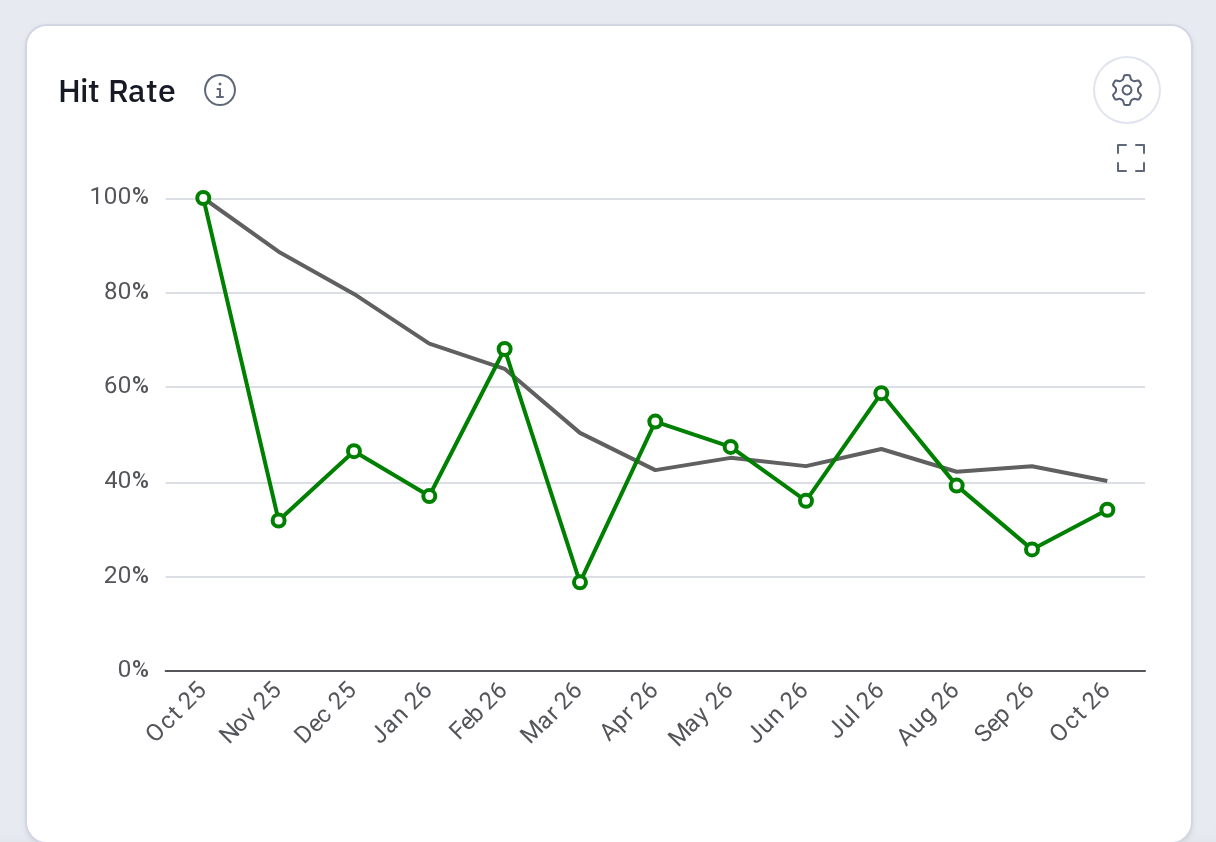
Hit Rate. Accepted proposals as a percentage of accepted and abandoned proposals, per month. By value, a discount or credit line (a negative price) reduces the value it belongs to. If credits outweigh a month's accepted or abandoned value, that value counts as zero, so the hit rate always stays between 0% and 100%.
-
On-time Delivery. The percentage of projects delivered on or before their deadline, per month.
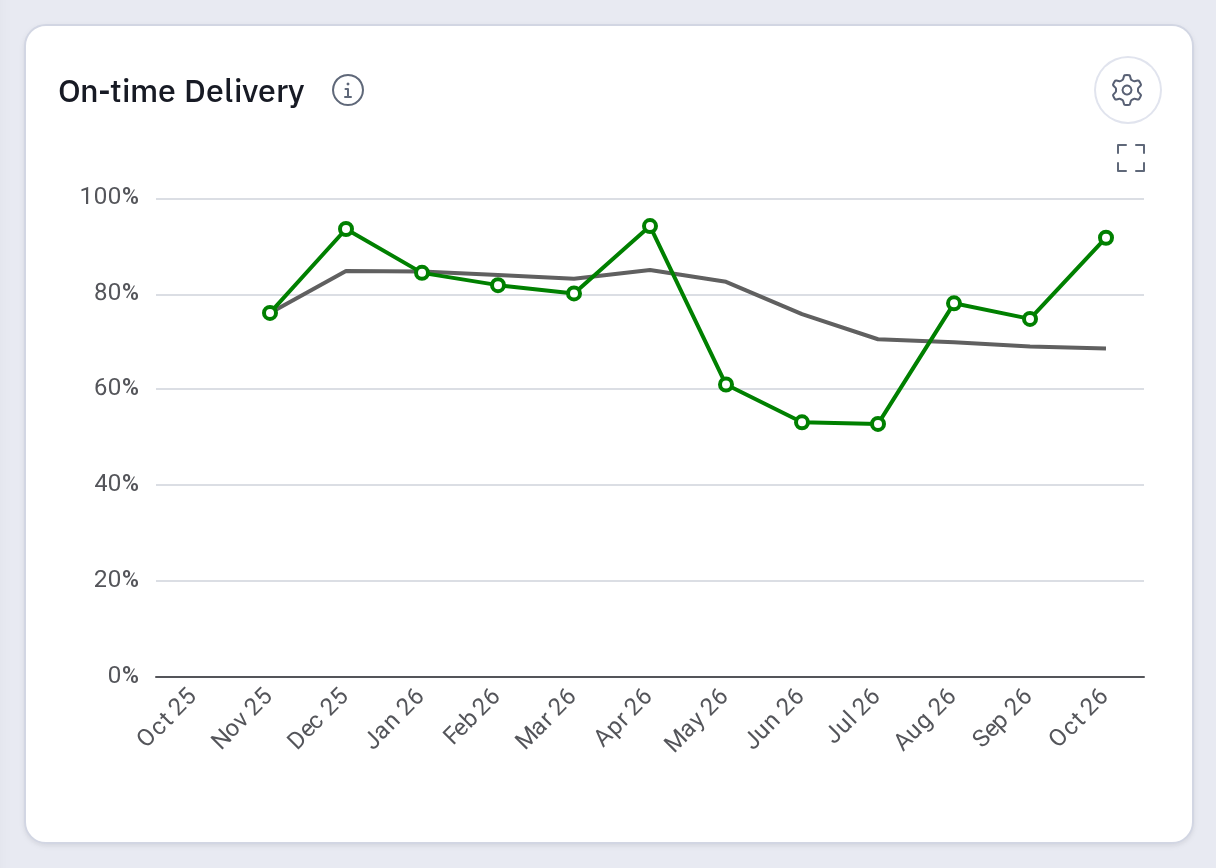
Both graphs can be shown by value or by count (the Type setting in the dashboard filter). The two can differ a lot: an abandoned proposal worth nothing lowers the hit rate by count (one proposal) but not by value. Likewise, on-time delivery by value weighs a $1,000,000 project far more than a $100 one, while by count each project weighs the same.
Billable Hours
Billable hours recorded per month, stacked by department, with a line showing the 6-month moving average. Hours recorded against non-billable projects, services or tasks are not included. Available Hours is the number of billable hours your team could have worked: Kompass adds up the billable days of every employee's schedule, less approved time off. The part of the available hours that was not recorded shows as an empty box. Hover over a bar to see the Utilization, the recorded billable hours as a percentage of the available hours. Available hours and utilization are shown only while the dashboard is unfiltered or filtered by department. It shows the capacity of your team and helps you decide whether to take on more projects or hire more staff.

Two questions decide how an employee affects the utilization: does their schedule have billable days, and have they recorded billable hours?
| Billable hours recorded? | |||
| YES | NO | ||
| Billable days in the schedule? | YES | 1. The hours count towards both the available and the recorded hours, as intended. | 2. The available hours count but nothing is recorded against them, which lowers the utilization. If the employee is not meant to work on billable tasks, give them a schedule without billable days. |
| NO | 3. The opposite of number 2: the recorded hours count but the employee adds no available hours, which raises the utilization above what the team really achieves. A month with recorded hours but no available hours at all shows a utilization of 0%. | 4. The employee does not affect the utilization. |
For the utilization to be right, every employee who is meant to work on billable tasks needs the right schedule. You can mark some days as billable and others as non-billable, which helps for employees who spend part of their week on billable work.
Schedules are set up in Kompass Admin, under Diary, Schedules. Create or edit a schedule and tick Billable for the days that count.

Organizations and Time Off

-
Organizations. Your organizations ranked by the value of their orders over the period chosen in the dashboard filter (12 months unless you change it).
-
Time Off Requests. Time off requests you can approve or reject that have not been decided yet. Which ones you see depends on your permissions, for example the employees you manage or your department. Click a name to open the request.
-
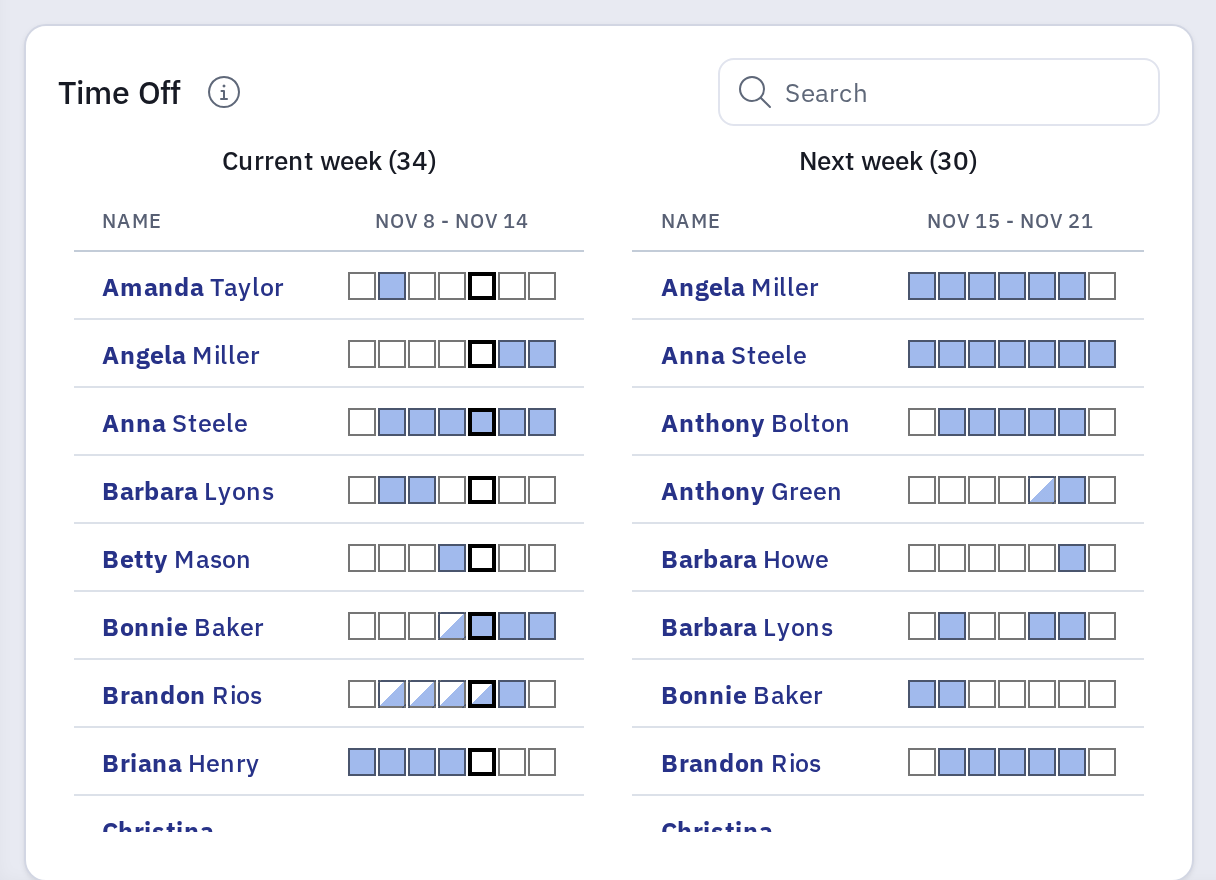
Time Off. Who is off this week and next, day by day. A blue cell means approved time off and a white cell means none. A cell split diagonally into blue and white means time off of less than a full day, such as a half day. Time off spanning several days shows every day as a full cell, even if part of it is a half day. Today's cell has a bold border.
If you don't see the sections above, contact your company's Kompass administrator.
The classic design shows the same figures, lists and graphs on one page without tabs, with a settings button at the top right instead of the filter.

- Compare last month's value of open, won and lost proposals for one department. You might want to work out the following rates: Quoted/Open, Won/Lost, Won/All Opportunities. What do these rates suggest for that department?
- What is the purpose of the line in the Billable Hours graph?
- You open your dashboard and see that on-time delivery for the past 2 months is 50%. What does that mean? Who would you most likely contact to address this?
- You open your dashboard and see that the hit rate for the past 2 months is 0%. What does that mean? Who would you most likely contact to address this?
- What is the difference between the Proposals to Submit and the Proposals to Chase lists?

Test your knowledge by completing this quick test.