Project
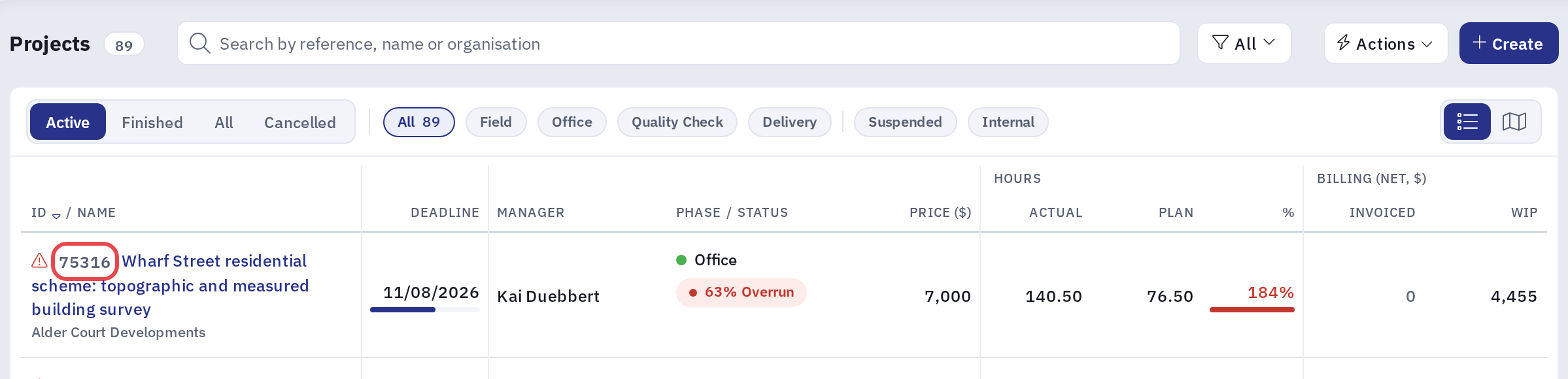
Projects store the most important information about your projects and operations. In the main view, there is a list of columns with the following information:
| COLUMN NAME | DESCRIPTION |
| ID | Unique Kompass ID. That can be changed to a project reference upon request (a reference like 24-0329) |
| Name | Project Name |
| Organization | Project's client |
| Phase | Phase of the project. For Active projects it can show that the project is currently on field, processing, under quality check or ready to be delivered. For Finished projects, it can show whether the project is ready to be invoiced, unpaid or paid. |
| Status | By clicking the status update of the project, you can record the status valuation, either as a percentage of completion for lump sum proposal items or an amount of rates for rate and T&M proposal items. |
| Price | Price of the project |
| Deadline | Deadline of the project |
| Manager | Project manager of the project |
| Hours (Plan) | The amount of budgeted hours for completing the works |
| Hours (Actual) | The hours recorded from your employees. That column is being automatically updated when employees are recording their timesheet. |
| % | Actual worked hours over budgeted. Provides a quick overview of the performance of the project. While read in conjunction with the status update, it helps to monitor whether you are on budget or overrunning. |
The list also shows Invoiced and WIP in the Billing group, and more columns on wide screens.
You can open a project from the Projects page by selecting its row.
The project page varies with your Kompass permissions:
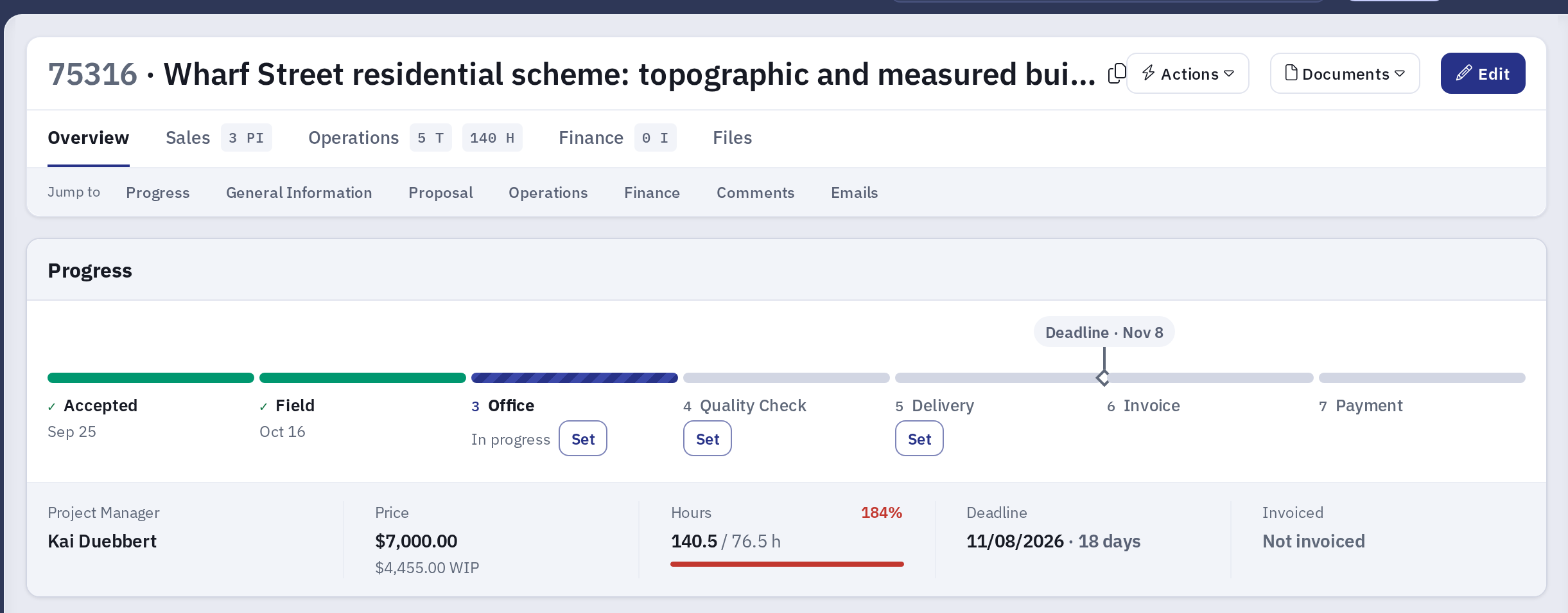
Project tabs:
- Overview tab: (Available to all users) This tab holds the information most relevant to the assigned task.
-
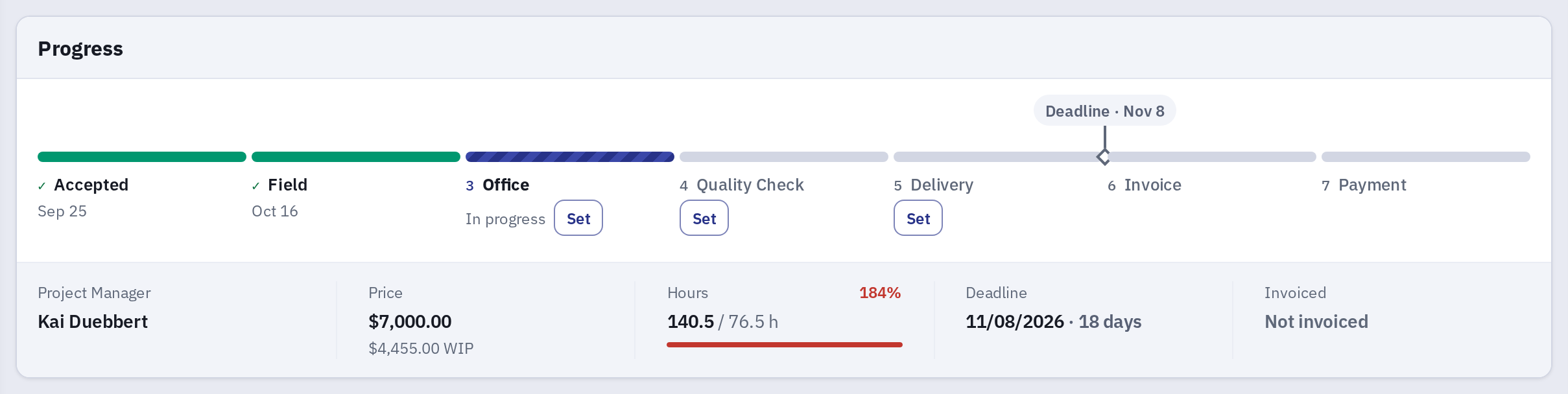
Progress section (Available to all users) shows a quick view of the project's progress.
-
General section (Available to all users) holds the project's main details.
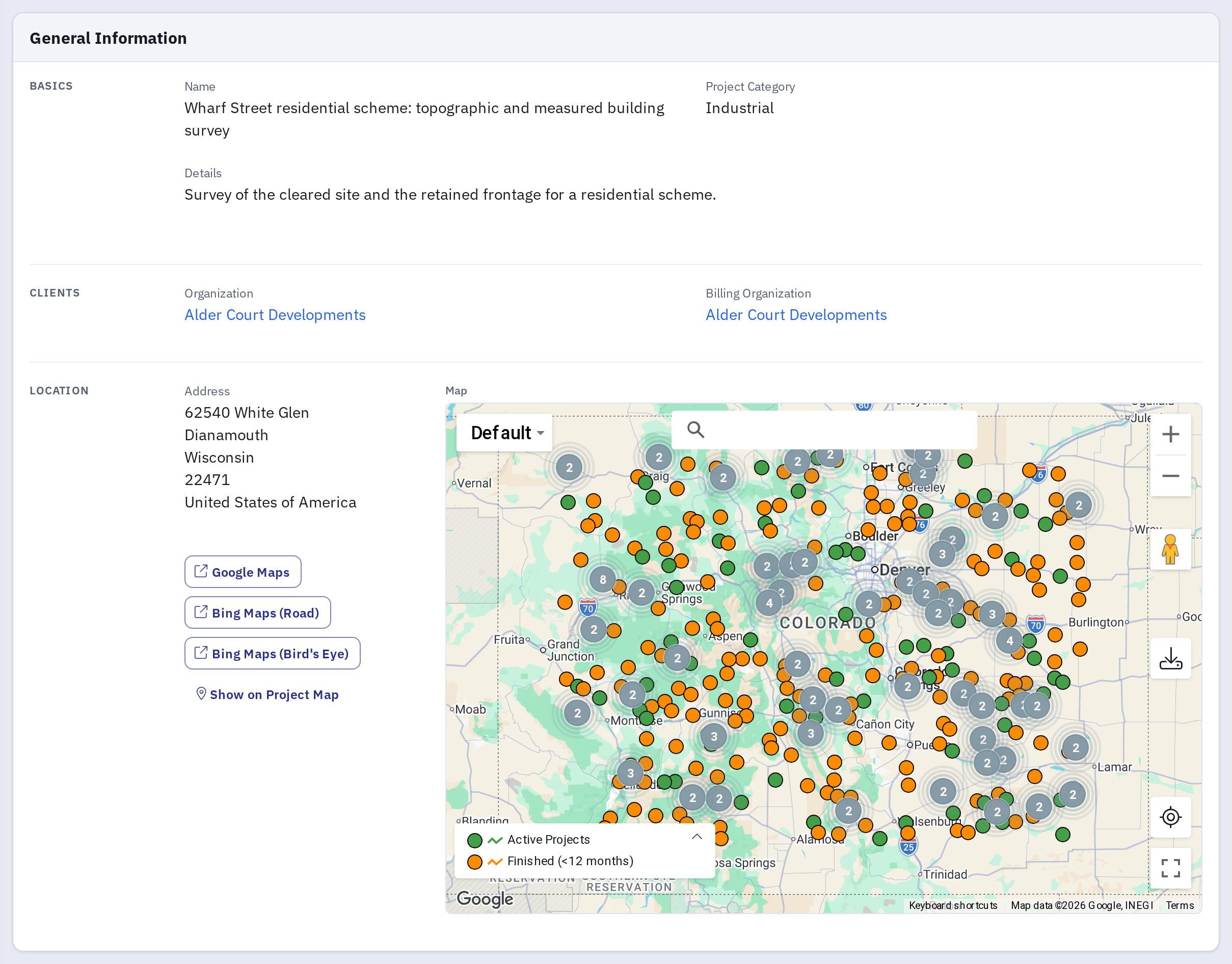
- The project ID, name, category, organization (client) and details. These relate to the whole project, not to individual tasks.
- The site address and internal notes. You can open the site location in Google Maps or Bing Maps.
- The project's geographic location and the work area it covers. You can show previous project locations by age; the map starts with active projects and projects finished in the last year. Use the legend to change which projects are shown.
-
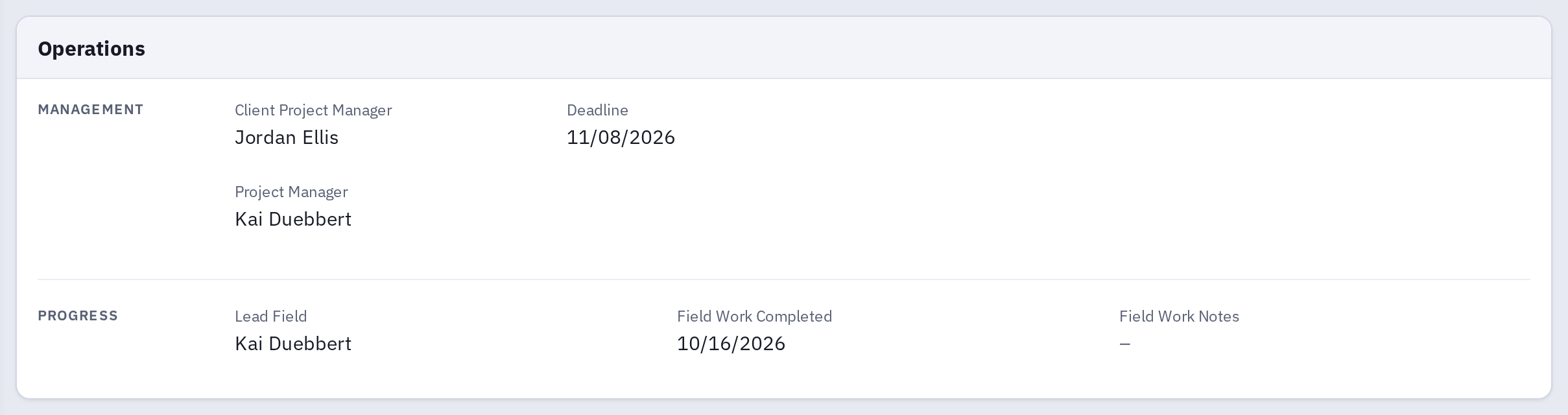
Operations section (Available to all users) shows operations information: client representative, deadline, project manager, and the lead for field work, office work, quality check and delivery, with dates for each completed step and notes between steps.
-
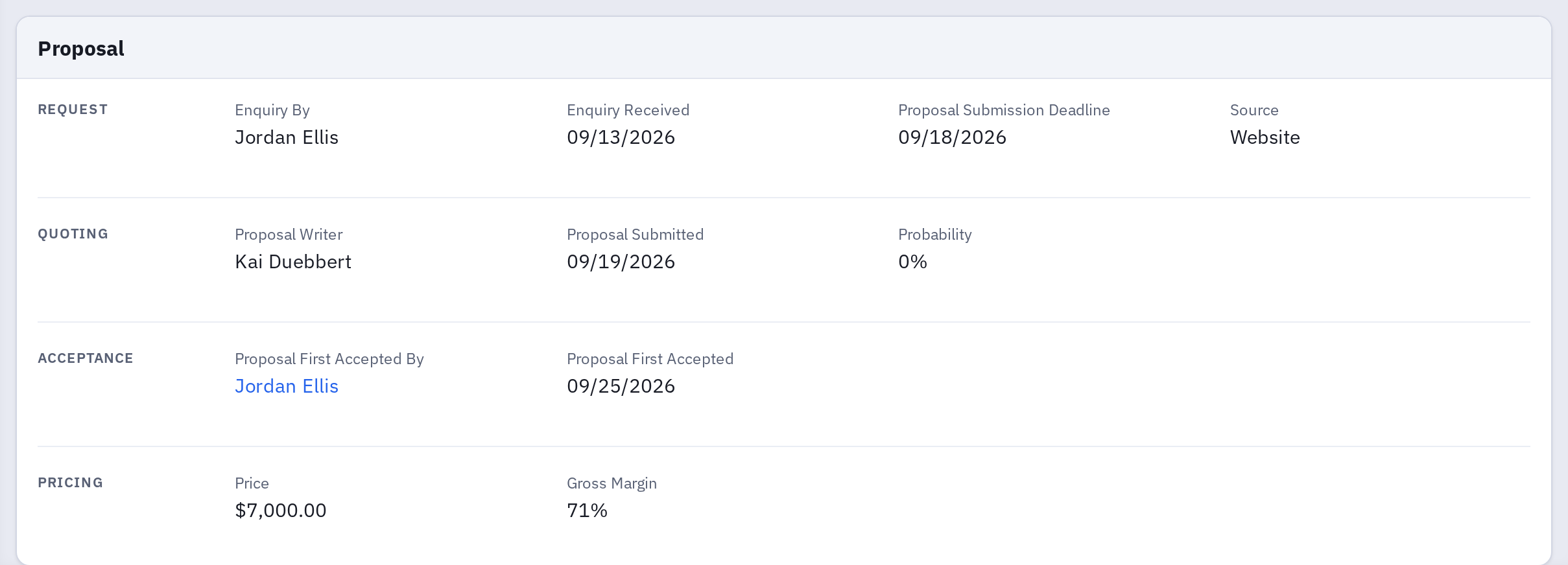
Proposal section (Available to users who can see project financials, or when a custom field is placed there) Holds commercial information about the acceptance or abandonment of a project. It shows the contact who inquired (Enquiry By), the proposal writer from your organization and their Probability assessment, the Source the client came from, and the contact who accepted the proposal (Proposal First Accepted By). You can also add, view and edit the inquiry date, Proposal Submission Deadline, proposal submission date and expected award date. The acceptance date is shown read-only; acceptance is recorded through the acceptance actions on the proposal items. Once the proposal is confirmed, you can define how the order was confirmed (contract, purchase order, sales order and so on). If the proposal is abandoned, the details are at the bottom of the section.
-
Finance section (Available to users who can see project financials, or when a custom field is placed there) Not to be confused with the Finance tab. This section stores the client's invoice contacts, the person in your organization who issued the invoice, and the payment with its dates and notes. These fields relate to the final payment of the project. The Finance tab is described below.

-
Comments section (Available to users who can see comments) Lets users read comments. Leaving a comment requires permission to add comments, and attaching a file requires permission to add comment files. Users can also notify colleagues by email by mentioning them with @ in the message.

-
- Sales tab: (Available to users who can see proposal items) This tab holds the proposal items of the project.
-
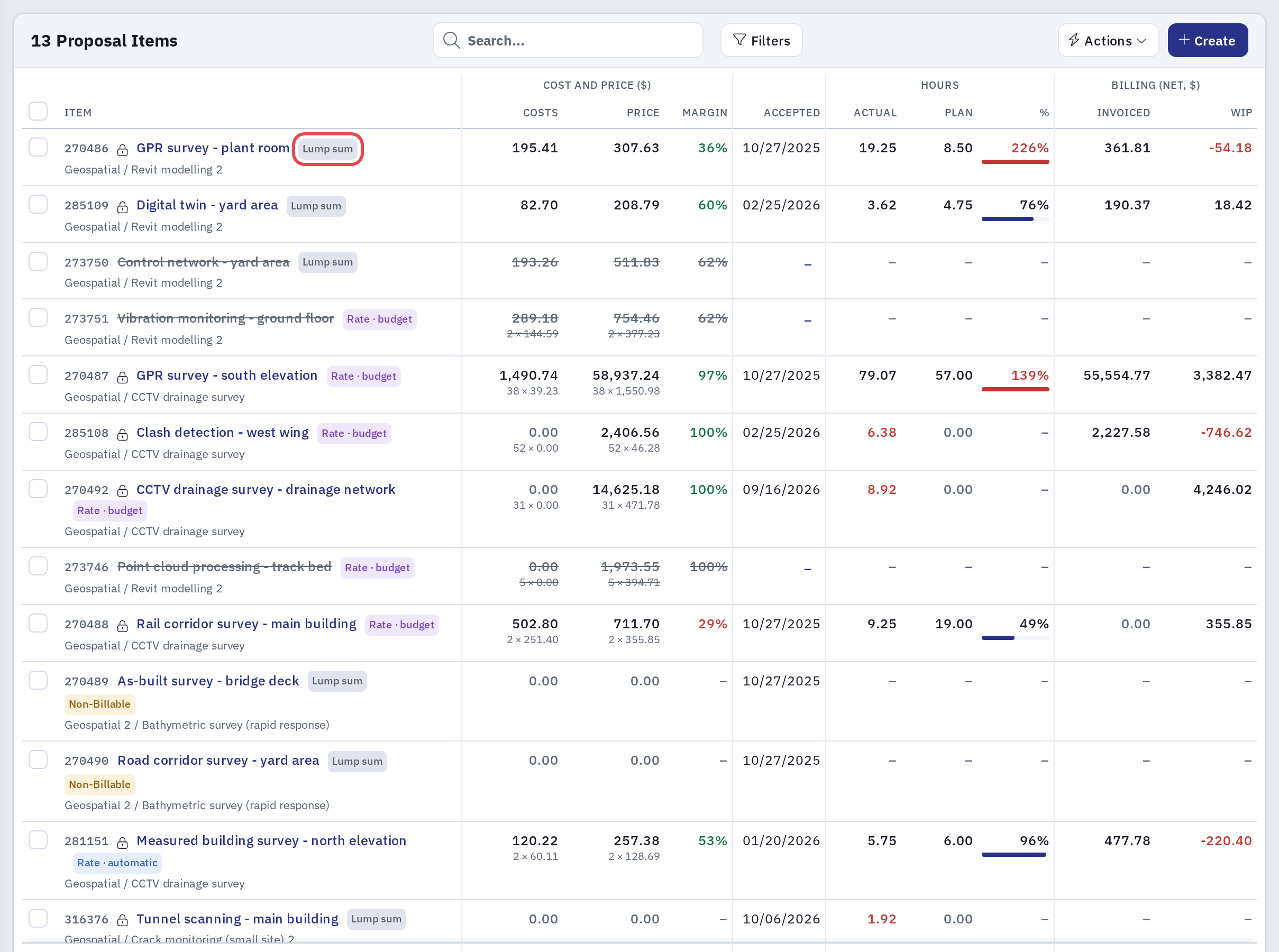
All proposal items are listed here. The view shows the allocated department of each proposal item, the planned field and office hours, any subcontractor work, the total price, the gross margin for each proposal item (red when below the target margin), acceptance details, and the budgeted hours against actual recorded hours with the percentage used.
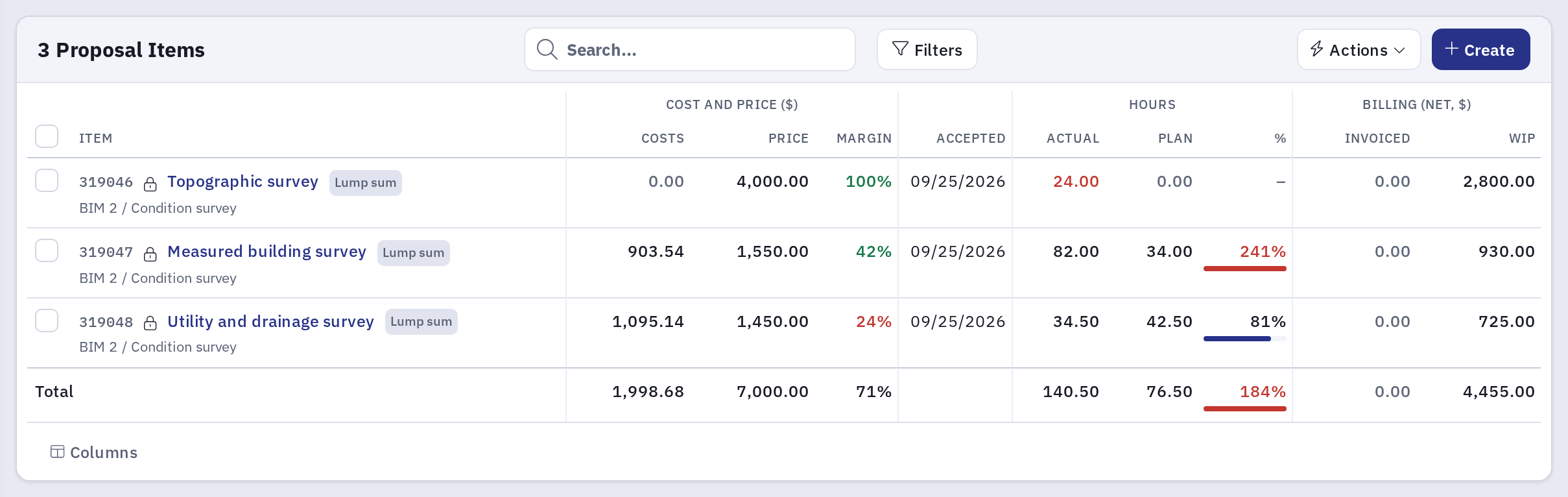
Each proposal item shows its price type: Lump sum, Rate · automatic or Rate · budget. See Price Types for what each type means. In most browser windows the type is shown as a label to the right of the item's name. On large monitors, when the table is about 1,600 pixels wide or wider (roughly a 1,900 to 1,920 pixel browser window with the navigation open), it has its own Type column, before Costs; if you hide that column in the Columns menu, the label by the name is shown instead. On phones the type appears under Pricing on each item's card.
For rate items, the small line under Costs shows the quantity times the unit cost, and the line under Price shows the quantity times the unit price (for example, 20 × 876.53). Lump sum items show the total only.
Proposal items excluded from the proposal (Visibility set to Exclude from quote) are grayed out, as are the items grouped under them, and their name, costs, price and margin are struck through.
-
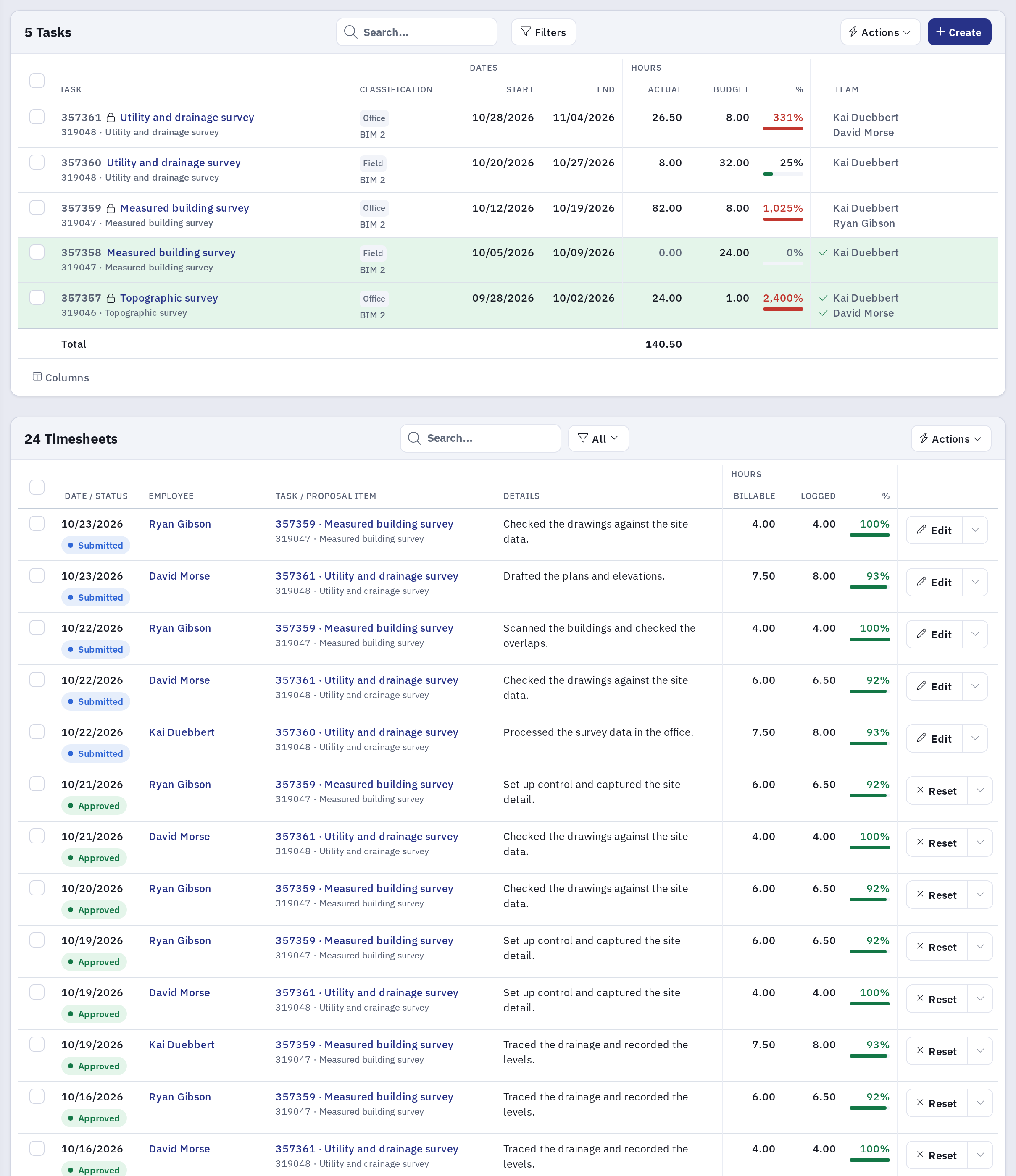
- Operations tab: (Available to users who can see tasks, timesheets or status) This tab holds the tasks and hours recorded against the project.
- All tasks related to this project are listed here.
- Employees record timesheet entries against the project's tasks, and those entries are listed here.
-
The Status section at the bottom is shown to users who can see status updates.
-
Finance tab: (Available to users who can see project financials and at least one type of record in the tab; each section has its own permission) Not to be confused with the Finance section on the Overview tab. This tab shows the invoices raised against the project and its valuations.
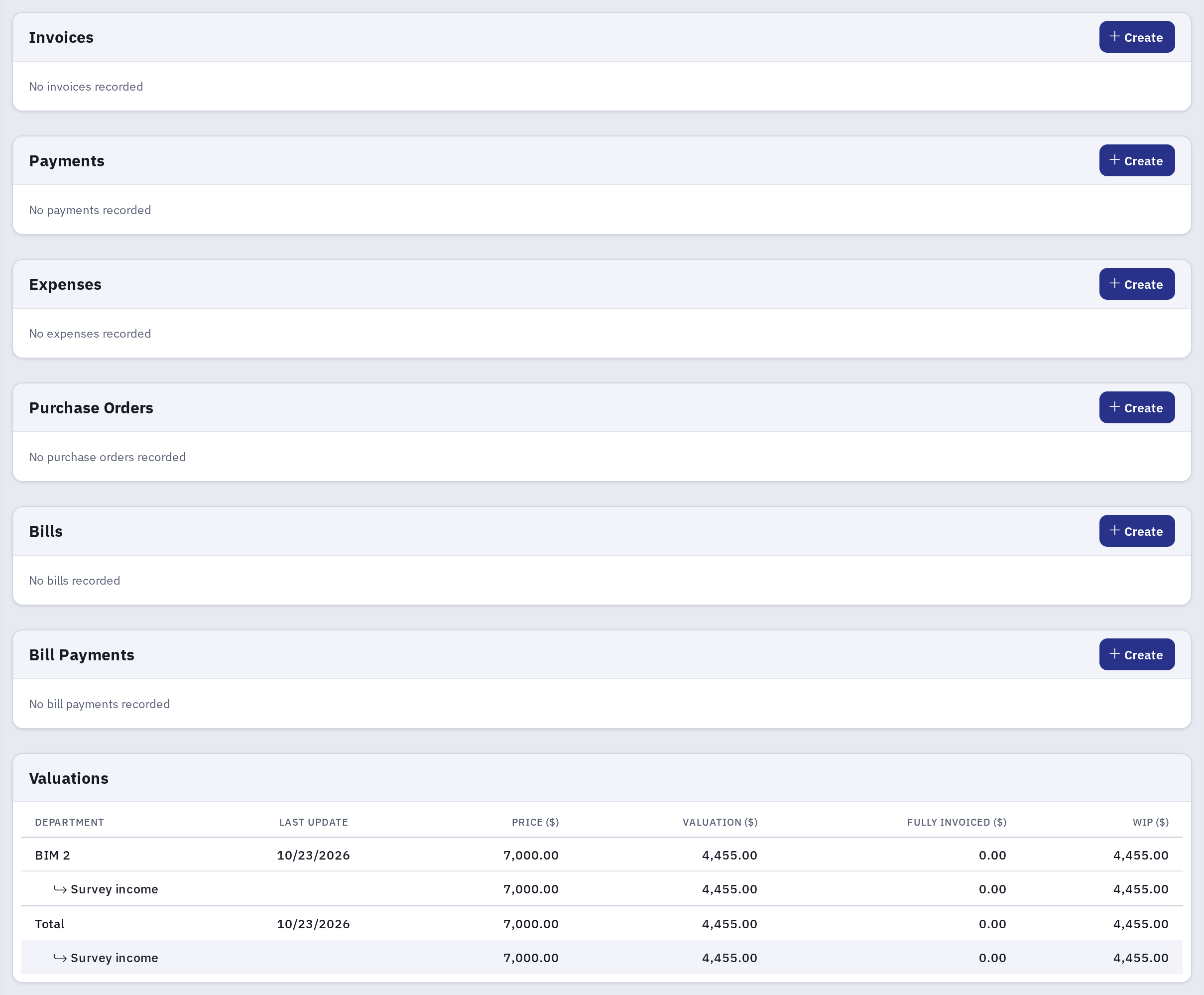
- All invoices raised against the project are listed here. The table shows the date, invoice ID, internal reference, details (the project name unless changed), type (invoice, journal or credit note) and net amount.
- Payments received from your client for those invoices.
- Expenses allocated to the project, with description, date, the employee who filed the expense, amount and status.
- Read the Valuations section together with the Invoices section. It gives a quick overview of Work in Progress (WIP), the work carried out that could be invoiced. WIP is shown by department and nominal account (core or subcontractor). The table below explains each column and where the information is entered.
| COLUMN NAME | DESCRIPTION | ENTRY POINT |
| Department | Depending on the department and scope of the proposal item that the project manager is setting its status, Kompass will show figures accordingly. | Sales representative. Department and scope are set during pricing and can be viewed on proposal items. |
| Last Update | Occasionally project managers will report the status of their projects in a form of a percentage of completion or number of rates of works under a proposal item. This field shows when the latest update took place. | Project manager. For more information on setting project status, see here. |
| Price | Total price per department and nominal account. | Sales representative. Price set during pricing and can be viewed and edited on proposal items. |
| Valuation | Value of the work completed, based on the status provided by the project manager. For a lump sum item this is the completed percentage of the price; for a rate item it is the completed units multiplied by the unit price. | Project manager will set the status update and Kompass will show the value of works completed. |
| Invoiced | Amount that has been already invoiced as can be seen in the Invoices section of the same page. | Accounting. Whenever a new invoice is being issued, these values are automatically updated to present the up-to-date invoiced amount per department/ nominal account. |
| WIP | Difference between valuation and invoiced. Work in progress amount. | Automatically calculated by Kompass. Effectively the amount that can be invoiced to the client. |
For further info on how to record project status, see Tutorials, Record Project Status.
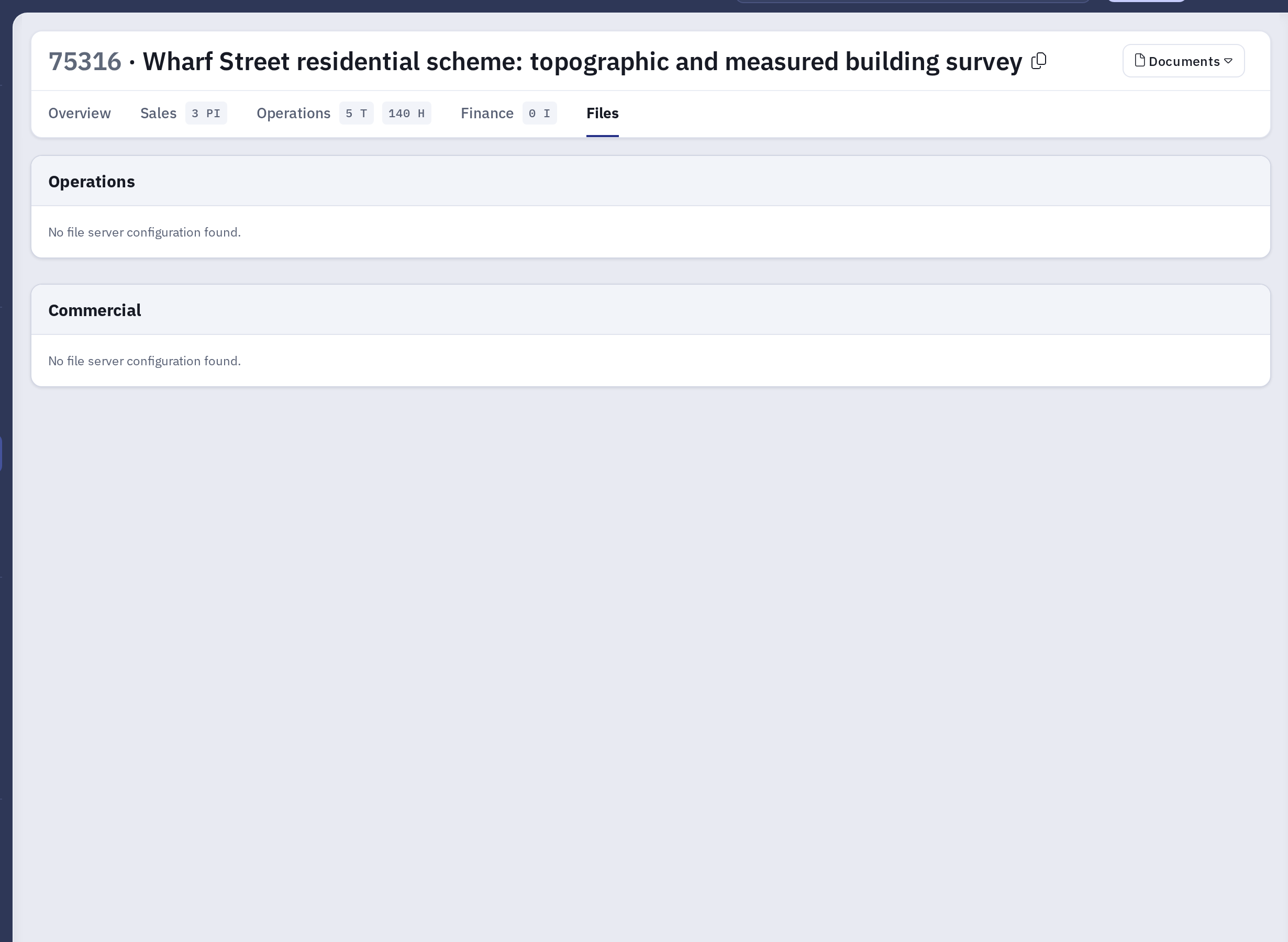
- Files tab: (Available to all users) Depending on your Kompass setup, you can download files from your company's server to your laptop or phone. This is useful when you are in the field without the documents you need.
- The Operations section usually holds information available to all employees.
-
The Commercial section usually holds commercial information for sales representatives, managers and directors.