
Project performance report (PPR): concept
The Project Performance Report (PPR) is a detailed export for monitoring and analyzing your projects. It has well over 200 columns, most of them numbers, so this article explains what they mean.
Exporting the report
- Open Projects, click Actions and choose Projects Performance.
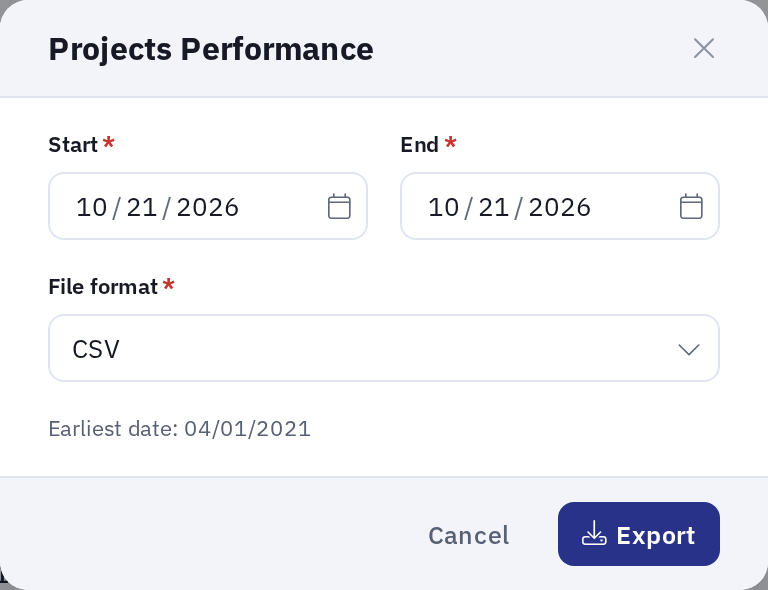
- Set the Start and End dates of the period you want to compare. The period can be at most one year, cannot start before April 1, 2021, and cannot be in the future.
- Choose the File format, CSV or JSON, and click Export.
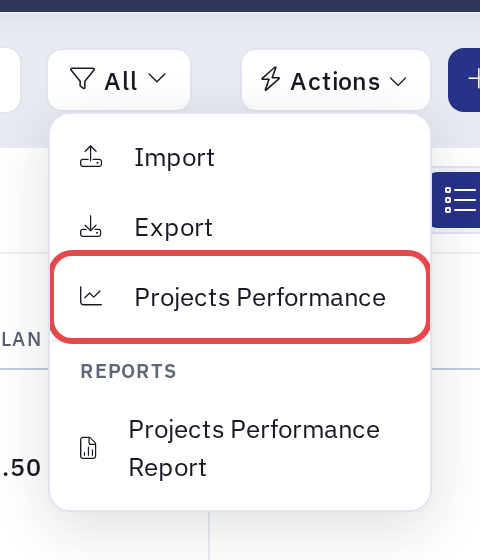
Use the Projects Performance entry itself. Anything listed under Reports below it is one of your organization's report templates (the screenshot shows one named after this report), which is a separate feature with its own layout.
The menu entry appears when you have one of the PPR export permissions (see A note on permissions). For the other exports on this menu, see Different types of exports.
How the report is laid out
The PPR compares the start and end dates you set. Each numeric value (price, hours, costs and so on) therefore has three columns:
- _start: the value at the start date
- _end: the value at the end date
- _change: the difference between the two
For example, price_budget_start, price_budget_end and price_budget_change. The status columns put the date first instead: status_start_value, status_end_value and status_change_value.
Each row is a proposal item split by nominal account, so a proposal item whose costs use more than one nominal account produces one row per nominal account. The proposal item's amounts are split across those rows by nominal account, so add the rows up to get the proposal item's total. The unit price is not split: it repeats on every row. Rows where every value is zero at both dates are left out.
Currencies
A project can have its own currency. Most amounts are in the project's currency, and a matching _base column gives the same amount in your organization's base currency, for example price_budget_base_end next to price_budget_end. For the status value the column is status_end_value_base, next to status_end_value. Use the _base columns when you total amounts across projects. Expenses, supplier bills, bill payments and the price and costs of hours are always in your base currency. For more on project currencies, see How multi-currency projects work.
| Field | Description |
|---|---|
| currency_code | The project's currency. |
| currency_rate | The project's exchange rate to your base currency (1 for a project in your base currency). |
Descriptive fields
These columns identify the project, the proposal item and the people involved. They describe the row rather than measure it.
| Field | Description |
|---|---|
| project | The project the row belongs to: its ID, reference, name, tags and created date, and when it was abandoned, by whom and why. |
| quote_item | The proposal item: its ID, name, display name, reference, visibility, billable flag and closed date. The display name is the proposal item's name in your organization's display format for proposal items. By default it is the same as the name. |
| quote_item_parent | The parent proposal item (ID, name, reference), where the item sits under a group. |
| nominal_account | The nominal account this row's figures are coded to. |
| service | The proposal item's service, with its billable flag. |
| department | The service's department, with its billable flag. |
| category | The project's category. |
| client | The project's client organization, with its category and tags. |
| billing_client | The organization the project is billed to. |
| accepted | The date the proposal item was accepted. |
| accepted_by | The contact who accepted the proposal item. The accepted_by_contact columns hold the same values under their newer name. |
| requested_by | The contact who requested the project. The requested_by_contact columns hold the same values under their newer name. |
| quoted_by | The user who wrote the proposal. |
| managed_by | The project manager. |
| delivered_by | The user who delivered the project. |
| invoiced_by | The user who invoiced the project. |
| deadline | The project deadline. |
| delivered | The project's delivered date. |
| invoiced | The project's invoiced date. |
| price_type | Whether the proposal item is a lump sum or a rate item. |
| quantity_auto | For rate items, whether the quantity is taken automatically from the latest status. |
| billable | Whether the row is billable: true only when the service, its department and the project category are all billable. |
| project_phase_start / project_phase_end | The project's phase at the start and end dates. |
| quote_item_udf_start / quote_item_udf_end | The proposal item's custom field values at the start and end dates, in one column each. |
| project_udf | The project's custom field values at the end date, in one column. |
| _metadata | The report's own start and end dates, when it was created and by whom. |
Price and value fields
| Field | Description |
|---|---|
| price_budget | The proposal item's price, as set on the proposal item page. For a rate item, the unit price times the quantity. |
| price_unit | The unit price. For a lump sum it is the same as the lump sum price. It repeats on every row of the proposal item. |
| status (date, quantity, value, notes) | The latest status at the start and end dates: its date, percentage or quantity, earned value and notes. A lump sum on a delivered project shows a status of 100%. The change columns give the movement in quantity and value between the two dates. |
| wip_standard | Work in progress by invoice date: earned value minus the amount invoiced by invoice date. |
| wip_billing | Work in progress by billing date: earned value minus the amount invoiced by billing date. |
Work in progress is zero from the date a project is abandoned.
Costs fields
| Field | Description |
|---|---|
| costs_budget | The proposal item's cost, as set by the cost lines on the proposal item page. For a rate item, the cost per unit times the quantity. |
| costs_hours_actual_total | The paid hours, each multiplied by the user's cost rate (from their user rates). |
| costs_hours_actual_field | As above, for hours recorded on field tasks only. |
| costs_hours_actual_office | As above, for hours recorded on office tasks only. |
| costs_hours_actual_other | As above, for hours recorded on any other task type. |
Price of hours (billing value of billable time)
These columns value the billable hours at each user's billing rate.
| Field | Description |
|---|---|
| price_hours_actual_total | The billable hours, each multiplied by the user's billing rate (from their user rates). |
| price_hours_actual_field | As above, for hours recorded on field tasks only. |
| price_hours_actual_office | As above, for hours recorded on office tasks only. |
| price_hours_actual_other | As above, for hours recorded on any other task type. |
Hours fields
Hours are grouped by type of hour (worked, paid, billable, non-billable) and then broken down by task type (total, field, office, other). They come from submitted and approved timesheet entries.
| Field | Description |
|---|---|
| hours_actual_worked_total | All hours worked. |
| hours_actual_worked_field | Hours worked on field tasks. |
| hours_actual_worked_office | Hours worked on office tasks. |
| hours_actual_worked_other | Hours worked on any other task type. |
| hours_actual_paid_total | Hours worked with your pay rules applied, such as overtime multipliers (see Working with multiple hourly rates). |
| hours_actual_paid_field | As above, for field tasks only. |
| hours_actual_paid_office | As above, for office tasks only. |
| hours_actual_paid_other | As above, for any other task type. |
| hours_actual_billable_total | Hours worked minus non-billable hours. |
| hours_actual_billable_field | As above, for field tasks only. |
| hours_actual_billable_office | As above, for office tasks only. |
| hours_actual_billable_other | As above, for any other task type. |
| hours_actual_nonbillable_total | Non-billable hours as recorded on timesheet entries (only if your organization uses the Non-billable field). |
| hours_actual_nonbillable_field | As above, for field tasks only. |
| hours_actual_nonbillable_office | As above, for office tasks only. |
| hours_actual_nonbillable_other | As above, for any other task type. |
Note: on a non-billable row, all hours worked count as non-billable: the billable hours and the price of hours are zero.
Invoices and payments
| Field | Description |
|---|---|
| invoices_standard | The net amount invoiced, by invoice date. |
| invoices_billing | The net amount invoiced, by billing date. |
| invoices_date_latest | The date of the most recent invoice for the proposal item. |
| payments | The net amount of payments received. |
Expenses
| Field | Description |
|---|---|
| expenses_billable | Approved expenses marked as billable to the client. |
| expenses_nonbillable | Approved expenses not marked as billable to the client. |
| expenses_total | All approved expenses, billable plus non-billable. Expenses that are not yet approved are left out. |
Supplier bills and bill payments
These columns bring supplier costs from Purchasing into the PPR, allocated to the proposal item and nominal account. Each has a net, tax and total figure.
| Field | Description |
|---|---|
| bills_net | Supplier bill amounts (net) allocated to the proposal item. |
| bills_tax | The tax on those supplier bills. |
| bills_total | Net plus tax of the supplier bills. |
| bill_payments_net | Payments made to suppliers (net) allocated to the proposal item. |
| bill_payments_tax | The tax on those bill payments. |
| bill_payments_total | Net plus tax of the bill payments. |
A note on permissions
- Which projects are in the report depends on your PPR export permissions: Export PPR (any) includes all projects, Export PPR (own projects) the projects you manage, and Export PPR (own department) the proposal items whose service belongs to one of your departments.
- The costs of hours and price of hours columns are filled only if you have permission to view user rates. Without it, they are empty.
For the full list of permissions, see the Permissions reference.